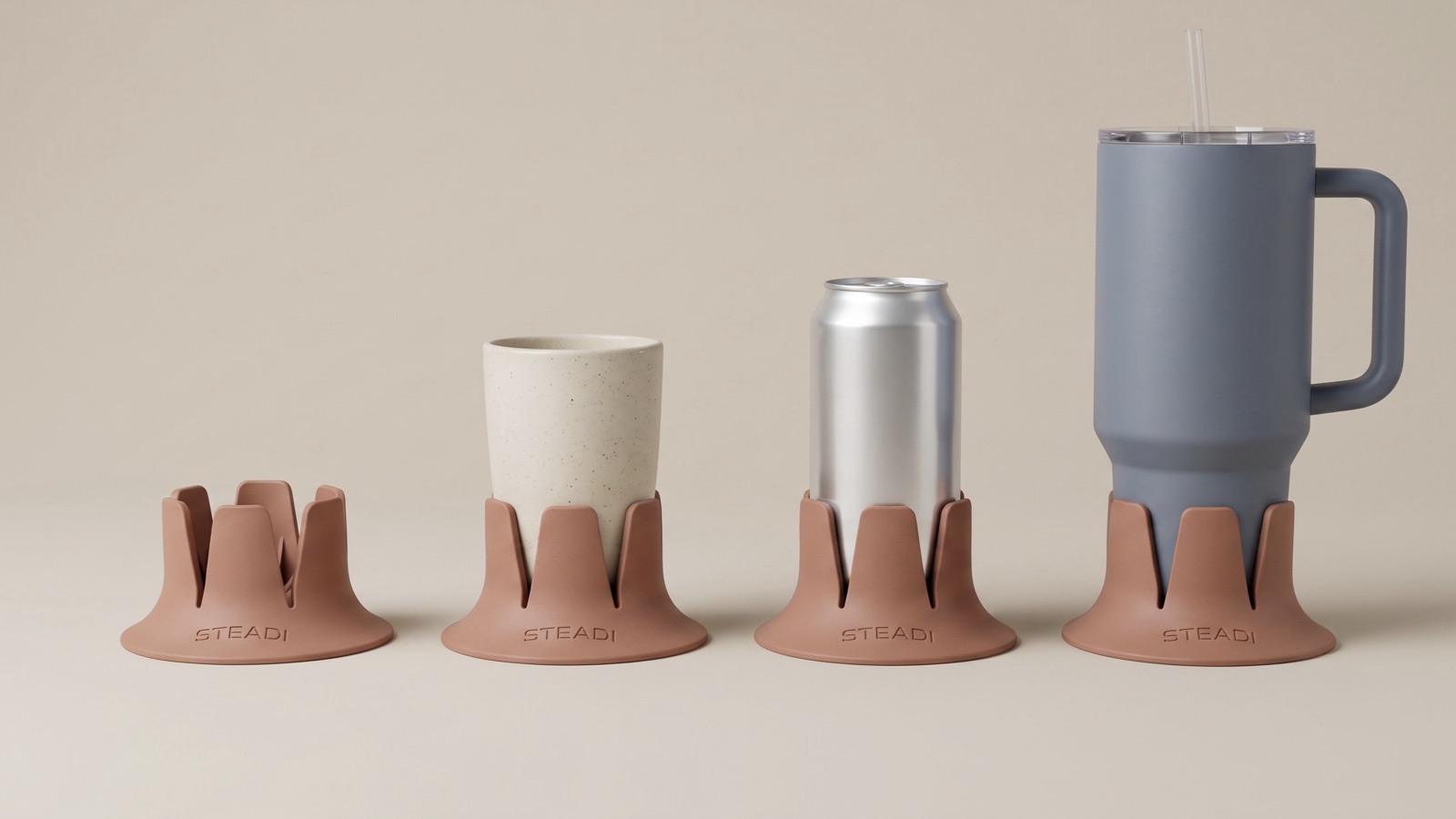
A flexible base that grips your tea, a can of sparkling water, or your 40 oz tumbler across the whole circuit — the sloped pool coping, the chair armrest that never quite locks, the wet stone at the hot springs rim. It doesn't float: drop it in the pool or the soaking tub and it sinks straight to the bottom like anything else set down in water, so it belongs on the deck and the benches around it, not in it. A rinse afterward is all it needs.
One flexible base. Empty, then herbal tea, a can of sparkling water, and a 40 oz tumbler — same grip, wet hands and steam included.
The situation
Every stop on the circuit is built to drain — not to hold.
A spa day is a loop through wet, hot, humid, and sloped surfaces, and the drink travels with you from lounger to bench to chair. Nothing along the way was designed to hold it — it was designed to drain water and keep bare feet from slipping.
The relaxation lounge.
Quiet rooms are often short on real furniture — one reviewer counted just three loungers for an entire pool and hot tub area. Whatever herbal tea or infused water you carried in from check-in travels the whole visit because there's rarely a surface waiting for it.
The pool deck.
The same slip-resistant tile that keeps a bare foot from sliding is sloped and drained on purpose — a design that sheds a sweating glass exactly as fast as it sheds a splash.
The pedicure or massage chair.
The molded cup ring built into the armrest fits one cup size and is mounted to a chair that reclines and adjusts under it — loose enough, often enough, that chair-parts suppliers sell replacement holder-and-armrest assemblies.
The rim at the hot springs, or the soaking pool.
Natural stone at the waterline is wet, uneven, and mineral-slick, with no flat spot to speak of — and most facilities ban glass near it outright, because a single broken shard at a bare-foot waterline is a hazard, not an inconvenience.
The cabana, if you can get one.
Shaded seating with an actual side table is usually limited, rented, or claimed early. Everyone else is on the ordinary lounge chairs — the ones already on record as having no holder and no table at all.
None of it ruins the visit. It's a string of small hand-offs — cup to tray to armrest to towel — that you make all day without noticing, until the drink is the thing you're managing instead of the soak.
You know the moment
The same cup, five stops around the circuit.
Robe on, fresh from the massage table
carrying the herbal tea from check-in to the relaxation lounge and counting three loungers for the whole pool and hot tub area — none of them within reach of a place to set it down.
Twenty minutes into the hydrotherapy circuit
a sweating glass of infused water balanced on the vitality pool's coping, the same sloped drainage grade currently running the condensation off its own side.
Mid-pedicure, feet still in the basin
the champagne pour or the coffee inching across a narrow armrest that shifts with every recline of the chair.
Between hot and cold rounds, seated on the cedar bench
a water bottle set down on slats built for airflow, angled and gapped so nothing — including a bottle — sits level.
Back on the heated floor mats after the last soak
iced sikhye in hand, with nothing around but the mat itself to set it on.
What you get
Three reasons it stays out.
01
Grips the slope, the wobble, and the wet.
The wide flexible base conforms to the pool deck's drainage grade, the reclining chair's shifting armrest, or the hot springs' uneven stone instead of needing a flat, dry perch that doesn't exist out here — and the fins grip the cup itself, so what's underneath doesn't matter.
02
Holds the drink that actually travels with you.
The handle-less tea cup, the infused-water tumbler, the capped bottle, the insulated 40 oz tumbler. Cans and bottles slide in; cups and tumblers drop through the fins and get held by the bottom inch, wherever the circuit takes them next.
03
Made for a robe pocket, not a pool bag.
One piece of matte flexible material in a muted color — no clip sized to one chair, no plastic-toy shine. It moves from robe pocket to lounge to bench in one hand, and it packs flat once the visit's over.
The fit test
Three inches, settled at the locker room counter.
your cup's base lands in here
A square sticky note: 3 inches, exactly.
01
Grab a sticky note.
The classic square is exactly 3 inches on a side — a fact about sticky notes, and it happens to be the ceiling of what fits.
02
Stand your cup on it before the robe goes on.
Do it at the locker room counter or the vanity, dry hands, before check-in ends — a sticky note and steam don't mix. Look at the base, not the rim; a tea cup and a tumbler both flare wider at the top.
03
Read the note.
Base sits inside the square, it fits. Hangs over the edge, too wide. A small puck lost in the middle — under about 2 inches — too narrow.
No spec sheet at the front desk, no guessing in the humidity of the steam room. One sticky note, checked before the circuit starts, with the cup you're actually bringing along.
Will it fit my cup
Measure the bottom, not the top.
One line covers the whole circuit: a container base about 2 to 3 inches across settles in and holds. Every verdict below follows from it.
Handle-less herbal tea cup fits
Infused water tumbler fits
Bottled water, capped fits
40 oz insulated tumbler fits
Standard 12 oz can fits
Slim seltzer can fits
Tritan stemless wine tumbler fits
Stemmed wine glass too narrow
Champagne flute too narrow
Smoothie or juice-shot glass too narrow
Sikhye cup fits
Handled ceramic coffee mug handle in the way
There's a floor as well as a ceiling: under about 2 inches — the champagne flute, the wine glass's stem, the juice shot — a base is too narrow for the fins to close around. The handled mug on the amenity tray is the honest exception: the base itself fits, the handle just lands where a fin needs to grip.
How it works
Three parts, no moving parts.
The base spreads across the slope.
Pool coping is graded to drain, chair armrests recline and shift, hot springs stone runs uneven underfoot — none of it is flat. The wide flexible base conforms to whatever's actually there instead of needing the dry, level ground this scene doesn't have.
The fins grip the cup, not the deck.
Flexible fins hold the container directly by its bottom inch, so a wet tile, a loosened armrest, or slick stone underneath doesn't change whether the drink stays put.
It settles back through the movement.
A chair reclines, a wave rolls through the pool, a foot lands wrong on the slope — the base flexes and holds the drink steady instead of letting the tilt finish the job.
Nothing clips to one chair, one rim, or one rental table. No armrest-specific tray to match to the chair, no clip sized to one pool's coping, no cabana required. It sits directly on the deck, the bench, the armrest, or the rim — on any stop along the circuit.
Read the deck
Every surface here is doing its job. Holding your cup was never it.
None of this is bad luck. The tile drains, the stone sheds runoff, and the chair reclines — all on purpose, just never for the cup balanced on top of them.
Pool deck and coping
Non-slip tile or raised, perforated stone is sloped and drained on purpose so wet feet don't slide — the same grade means nothing set on it ever sits level, and a cold glass's own condensation just adds to the film the tile is built to shed.
The steam room ledge
Tile or stone, sloped like the deck outside it, running warm in air that stays close to fully saturated — condensation beads and runs down every surface continuously, and most facilities ban glass here regardless.
The pedicure or massage chair armrest
A molded tray sized for one cup diameter, bolted to an armrest that reclines and adjusts with the chair — the mount is the failure point, worn loose enough by ordinary use that replacement holder-and-armrest kits are a stocked part.
The hot springs rock ledge
Natural or built stone at the waterline, uneven and mineral-slick with runoff — there is often no flat spot at all, just rock that was never shaped with a cup in mind.
The chaise lounge arm
Curved fiberglass, resin, or wicker, built to a body's shape and not a cup's — most lounge furniture in this scene simply has no flat surface within reach, integrated holder or otherwise.
Versus what you do now
What's already sold for this, and why it comes up short.
Floating pool or cocktail glasses (ball-and-stem 'beach glass' style)
Built to bob upright only in still, open water — any pool jet, current, or hydrotherapy feature tips them over, and they solve the problem for the water itself, not for the deck, the bench, or the lounger where most spa drinking actually happens.
Tritan or BPA-free 'pool-safe' unbreakable drinkware
It solves breakage and the pool-closure risk that comes with it, but the marketing itself stays silent on where the cup rests — and even the brands note that heavier drinkware gets harder to grip once it's wet or covered in condensation, which is constant out here.
The chair's own built-in cup holder
Molded to one cup diameter and mounted on an armrest that reclines and adjusts with the chair — loose enough, often enough, that replacement holder-and-armrest assemblies are a stocked spare part.
Renting a cabana or umbrella with a side table
Solves the problem only for the limited paid or first-come seats — the ordinary chaise lounges most guests actually use are the ones already on record as having no holder and no table at all.
Before you buy
Questions people actually ask.
Does it float?
No — worth saying plainly: drop it in the pool, the hot spring, or the soaking tub and it sinks straight to the bottom. Fish it out, rinse it off, and it's back to normal — a soak doesn't bother the material at all. It's built for the deck and the benches around the water, not for the water itself.
Glass is banned at my pool — does this count?
No. It's one piece of flexible material, not glass, so there's no shard risk if it's bumped or dropped. That said, the venue's glass ban usually applies to what's inside it too — check the house rules on your actual cup before you bring champagne or wine poolside.
Will my cup fit?
Measure the base, not the rim. A container base about 2 to 3 inches across settles in — a handle-less tea cup, an infused-water tumbler, and the 40 oz Stanley all land in that range. A champagne flute or a stemmed wine glass is the exception; the stem runs too narrow.
Does it work on the sloped, draining pool deck?
That's the surface it's built for. The wide flexible base conforms to the deck's drainage grade instead of needing the flat, dry footing a sloped surface never offers, and the fins grip the cup itself so the tilt underneath doesn't matter.
What about the pedicure or massage chair's built-in cup holder?
You don't need it. That holder is molded to one cup size and bolted to an armrest that reclines with the chair. This sits directly on the armrest, resists tipping as the chair moves, and holds whatever you actually brought — no swap for a different cup, no waiting on a loose mount.
Does it work on wet stone at the hot springs?
Yes — uneven, mineral-slick rock is exactly the kind of surface the wide base and the fin grip are built to handle. It settles in on the rim or the ledge instead of needing a flat spot that natural stone rarely offers.
I move through hot, cold, wet, and dry surfaces all day on the circuit — does it hold up to that?
Most of the circuit, yes — hard, flat, wet, sloped, and uneven surfaces are exactly what it's built for, from the pool deck to the hot springs rim to the chair armrest. The one exception is the dry sauna bench itself: that's a different kind of heat than a soak, and it isn't something we've put the base through, so treat that stretch of the circuit the way you always have.
Does it work on hard, flat surfaces too — a spa café table, the vanity?
Yes, at least as well as it does on the sloped and curved surfaces around the water. The wide base and the grip on the cup itself are just as useful on a hard, flat counter as they are on the pool coping or a chair armrest.
How do I clean it?
Rinse it under the tap or run it through the dishwasher — one piece of flexible material, nothing to unclip and nothing to come apart.
Who makes it, and where do I buy one?
It's called the Steadi, molded in small runs in Orange, California by Steadi Labs — veteran-founded and patent pending. Every order ships free from steadilabs.com, with 30 days to change your mind.
Who makes it
Made start to finish in Orange, California.
The maker is Steadi Labs, a small veteran-founded company in Orange, California. It's injection molded — the mold, the material, and the color runs all sit within about three and a half miles of the shop, and every batch is molded there in small runs. The people who make it are the same people who answer hello@steadilabs.com.
Thirty days, wherever you use it.
Use it for a month. If it doesn't do what this page says, email hello@steadilabs.com and it gets made right — no forms, no fight.
Veteran-founded · Patent pending · Made in Orange, California
Keep the tea in reach, all the way around the circuit.
Your drink rides the whole loop with you — lounge to deck to bench to rim — steady at every stop, so the only thing left to manage is the soak.